
Criminal Cases in the Shelby County Courts
Shelby County criminal court cases split by charge grade. The 123rd and 273rd District Courts hear the felony layer. Both list Suite 3 at 200 San Augustine Street in Center, while the District Clerk keeps their pleadings, indexes, judgments, financial entries, archives, and disposition reports in Suite B. The constitutional County Court handles Class A and B misdemeanor matters because Shelby County has no county court at law. Its records are kept by the County Clerk at 124 Austin Street.
Fine-only Class C cases can sit in one of five justice courts or in the municipal court that received the citation. Those files do not move to the District Clerk merely because they are criminal matters. The court that issued a capias or failure-to-appear warrant also remains the first place to verify that court record. Appeals from Shelby County go to the Twelfth Court of Appeals. Court level, not the arresting agency, tells a reader which clerk holds the authoritative proceeding file.
Two Shelby County Felony Court Records
The 123rd District Court, led by Judge LeAnn K. Rafferty, publishes a court phone of 936-598-9928 and links to public YouTube proceedings. In 2025, the Shelby County district court pages posted new decorum and temporary-restraining-order standing orders. The 273rd District Court, led by Judge James A. Payne Jr., lists coordinator Amber Dubea at 936-598-3201. A court page helps with settings and courtroom rules, but the clerk remains the source for filed papers and certified case results.
The official 123rd court source shows how Shelby County presents one of its two felony benches.
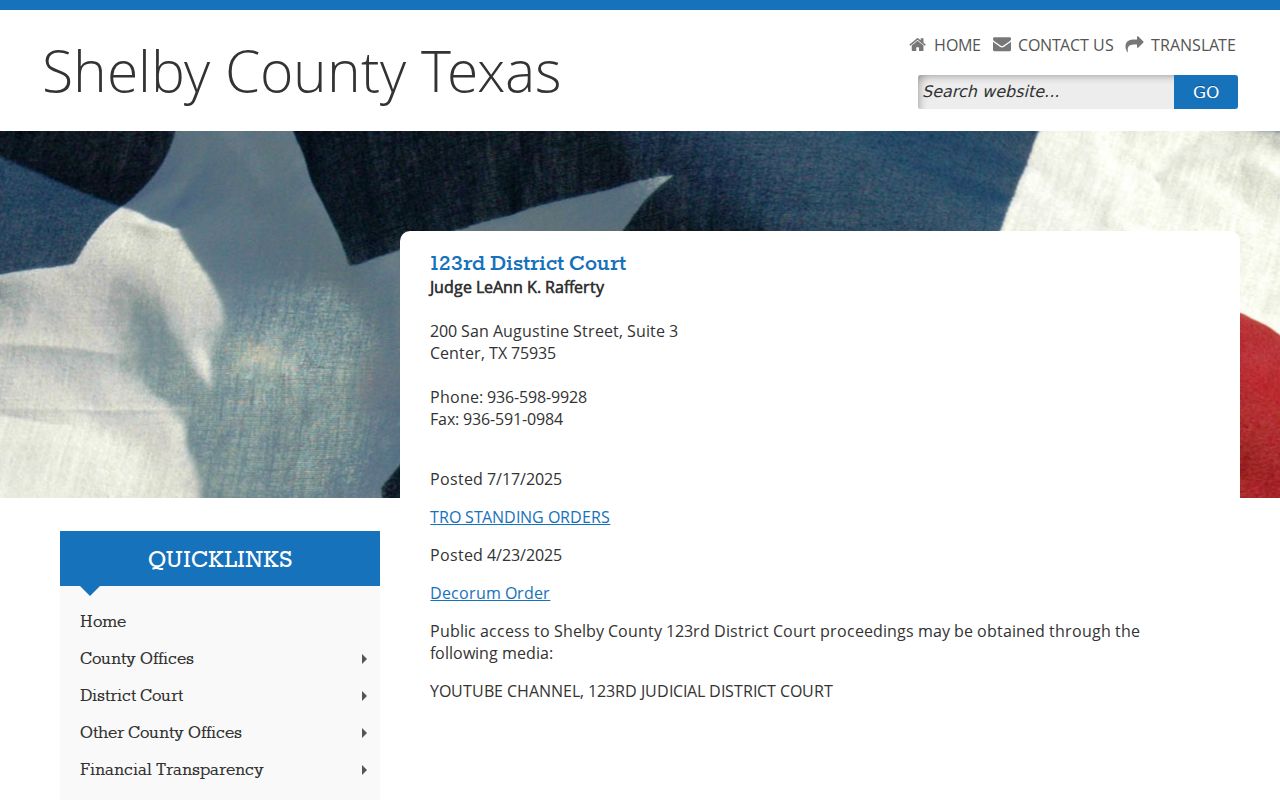
That court identity should be paired with the cause number when asking the District Clerk for a Shelby County criminal case file.
The official 273rd court source identifies the other felony bench in the same suite.
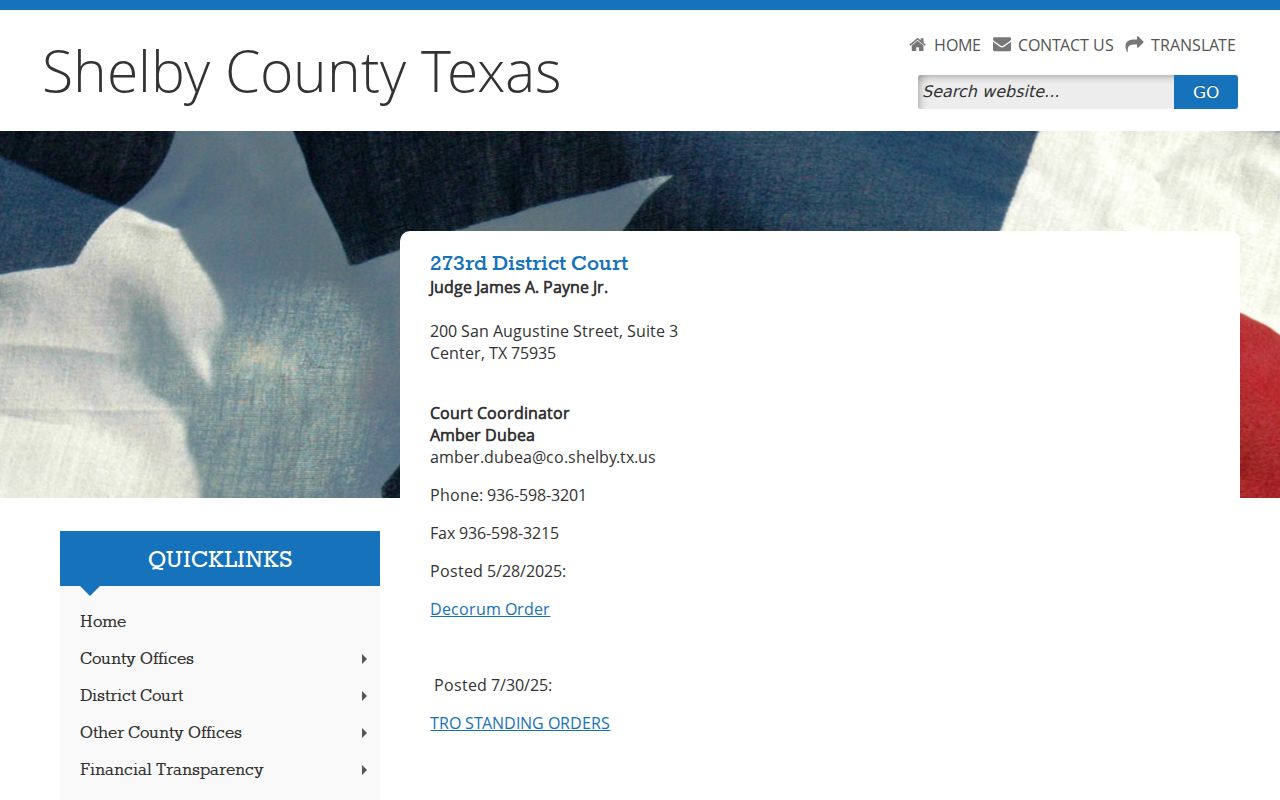
Shared space does not merge the dockets, so a court name or cause number can save a second search.
How to Search Case Records
No official Shelby County criminal-name portal or online document viewer was verified. A sound search uses the clerk who owns the case, with re:SearchTX treated only as a secondary check. Have the full name ready, plus a cause number and year when known. Ask for each product by name because a docket sheet, charging instrument, judgment, sentence, and certified copy answer different questions.
- Identify the charge level. Use the District Clerk for felonies, County Clerk for Class A or B misdemeanors, and the issuing justice or municipal court for fine-only cases.
- Call or visit the right Shelby County clerk. Give the full name and any known cause number or filing year.
- Ask for the docket, charging document, final judgment or disposition, sentence, and current copy or certification price.
- Check re:SearchTX only as a supplement. Do not treat a missing result as proof that no criminal case exists.
- For a statewide identity summary, use DPS separately, then reconcile any mismatch with the clerk that reported the Shelby County outcome.
The statewide interface supports account-based access, but research did not verify a complete set of Shelby criminal search fields. The only safely documented inputs are therefore limited.
| Search detail | Type | Required | Use |
|---|---|---|---|
| Party name | Text | Portal dependent | Find possible matching matters |
| Cause number | Text | No | Reach the exact docket when known |
| Court | Access level or filter | Portal dependent | Separate district, county, justice, and municipal files |
| Filing year | Date or year | No | Narrow common-name results |
The official re:SearchTX source shows the statewide interface and its access model.
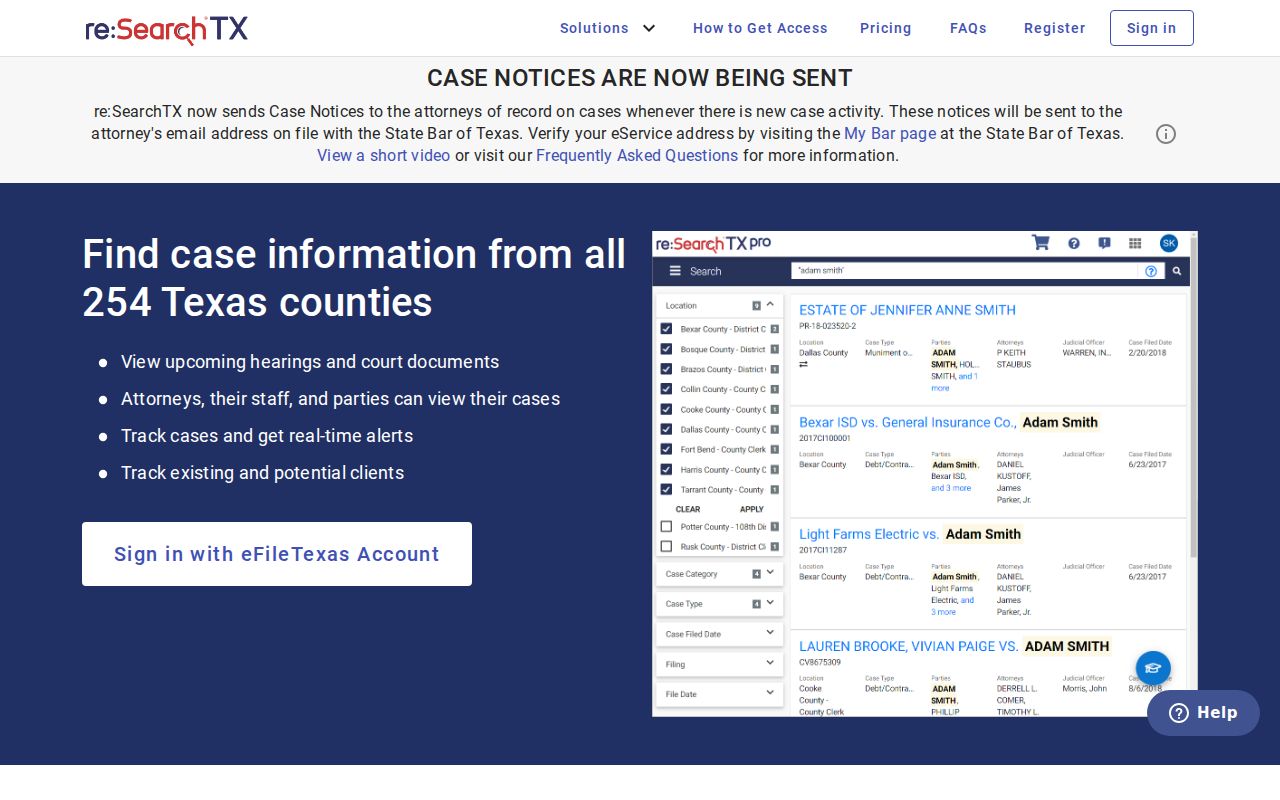
Its presence does not replace a direct Shelby County clerk request for the full criminal cause.
Shelby County Court Record Counters
The location split is easy to miss. The District Clerk works at 200 San Augustine Street, Suite B, Center, TX 75935. The counter is open weekdays from 8:00 a.m. to 4:30 p.m.; phone 936-598-4164. Mail goes to P.O. Drawer 1953 rather than the street address. The office holds Shelby County felony papers and preserved causes for both district courts.
The official District Clerk page is the source for that Shelby County felony-record route.
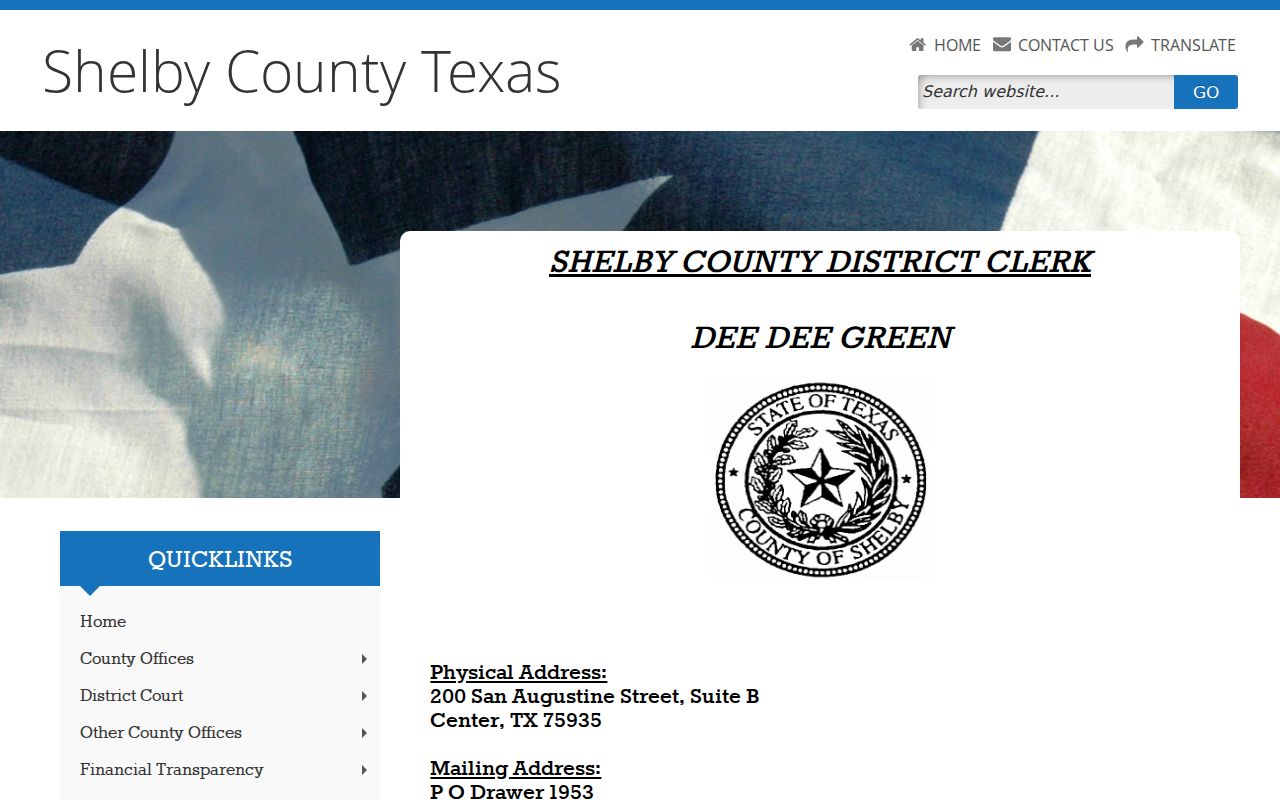
Readers should confirm copy and certification costs because no current criminal fee schedule was found.
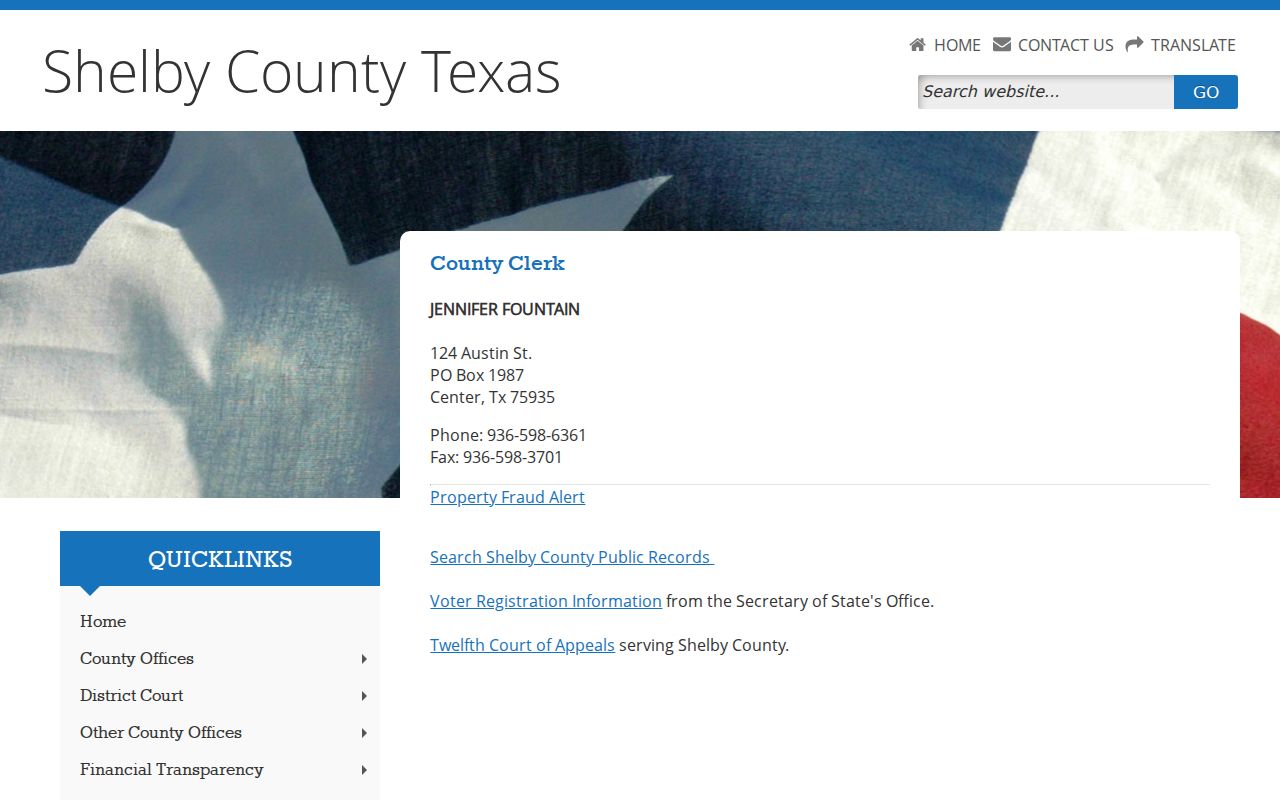
The County Clerk is at 124 Austin Street, Center, phone 936-598-6361. That historic courthouse office is the route for the county misdemeanor layer. Its general public-record link was not verified as a criminal portal, so a call or counter request is safer than assuming online coverage.
The County Clerk source shows the separate Shelby County misdemeanor custodian.
The two addresses reflect different court levels, not duplicate copies of one case system.
District Clerk
200 San Augustine Street, Suite B
Center, TX 75935
936-598-4164
Weekdays, 8:00 a.m.-4:30 p.m.
County Clerk
124 Austin Street
Center, TX 75935
936-598-6361
Confirm counter details by phone
What the Case File Shows
A Shelby County case file follows the court proceeding, not just the initial arrest. The charging instrument states what was filed. The docket gives the event trail. Pleas, motions, settings, judgment, sentence, costs, and an appeal notice can appear as the matter moves. Request the final signed judgment when the goal is to learn the legal outcome, since a search-result label or booking charge may not show later change.
| Cause number and court | Identifies the exact Shelby County proceeding and the bench that heard it. |
|---|---|
| Charging document | Complaint, information, or indictment stating the filed accusation. |
| Docket entries | Chronological record of settings, motions, pleas, rulings, and filings. |
| Hearing dates | Past and scheduled court events recorded by the clerk. |
| Disposition and judgment | Dismissal, acquittal, deferred adjudication, conviction, or pending status as recorded. |
| Sentence and conditions | Confinement, community supervision, fine, costs, and other terms in the order. |
Read Shelby County Criminal Case Outcomes
Three terms prevent common errors. A plea is the formal response to a charge. A disposition is the recorded result for that charge. A sentence is the penalty imposed after a conviction. They are separate fields, and one case can have more than one count with a different result for each. The DPS CCH guide also uses a Tracking Incident Number and suffixes to connect arrest, prosecution, and court segments.
- No-bill
- A grand jury declines to return an indictment.
- Dismissal
- The charge ends without a conviction.
- Deferred adjudication
- A plea is entered while a guilt finding is deferred during community supervision.
- Acquittal
- The result is not guilty.
- Conviction
- The court records an adjudication of guilt.
A Shelby County cause file is the best source for context. DPS may show a reported statewide segment, but it is not a substitute for the pleadings and signed orders in the local file.
Stages of a Criminal Case
A Shelby County felony can begin with arrest and magistration, then move to a complaint and grand-jury review. An indictment is a formal felony accusation returned by the grand jury. A county misdemeanor commonly proceeds by information. The assigned clerk opens and tracks the case, while the prosecutor may accept, reject, or revise the original arrest charge before judgment.
Case flow: Charges Filed › Arraignment › Pretrial › Plea or Trial › Disposition › Sentencing
Arraignment addresses the accusation and plea. Pretrial entries can reflect motions and settings. A plea agreement still requires court action. Trial can end in conviction or acquittal. The judgment and sentence state the final trial-court result, and an appeal can then move to the Twelfth Court of Appeals. No fixed local time for each stage was published, so readers should ask the assigned clerk about the current setting rather than rely on a generic timetable.
When Shelby County Case Outcomes Go Missing
A statewide record can show an arrest without a later outcome. DPS warns that not every history contains every segment. The gap may reflect agency lag, a rejected submission, or a disposition that the clerk has not yet reported. It does not prove that a case is still pending. Start with the Shelby County clerk that handled the cause and obtain the signed disposition or judgment.
The Shelby County District Attorney source identifies the felony prosecutor's office and its published phone, 936-598-2489.
The prosecutor may explain its own filing action, but the clerk's signed court record remains the source for the judicial outcome.
If the clerk file is right and the DPS entry is not, use the identity-linked correction route through the Texas Department of Public Safety. A fingerprint review helps avoid a name match to the wrong person. Keep the certified Shelby County document ready so the reporting or correcting agency can compare the disputed field.
Access & Restrictions
Texas Government Code Chapter 552 provides a public-information baseline for executive-agency records, with confidentiality and law-enforcement exceptions in sections 552.101 and 552.108. Judicial case files, however, are requested from the court clerk rather than the Office of Court Administration. Juvenile material, victim-identifying facts, confidential identifiers, expunged records, and information covered by an order of nondisclosure may be unavailable or redacted.
A case missing from a web search may still exist in paper or archived form. Ask the Shelby County clerk to check the name, cause number, and year. Do not infer that a sealed or absent result never existed. Current Texas expunction law is in Code of Criminal Procedure Chapter 55A, and a final qualifying order bars release, maintenance, dissemination, or use subject to narrow exceptions.
No Complete Shelby Criminal Case Portal
re:SearchTX is a real statewide court platform, but it is not a full statewide criminal-case search. A 2024 Texas Judicial Council report said its roughly 150 million documents generally excluded criminal case records. Shelby County also publishes no verified county criminal-name search, online viewer, date range, or current copy fee chart. That leaves a clear fallback chain: identify the court level, contact its clerk, request the exact documents, and verify the result in the signed file.
The Texas judiciary's case-record guidance directs readers to local clerks because the state Office of Court Administration does not hold individual files. The broader Shelby County criminal-history overview explains when DPS, jail, and fingerprint channels answer a different question.
Note: A portal miss is not a no-case finding; confirm the name and cause directly with the proper Shelby County clerk.