
Running a Sex Offender Check in Shelby County
The Texas Public Sex Offender Registry is the first official channel for a Shelby County registry search. Texas DPS compiles information sent by local registration authorities and makes the public portion available without a fee. It can answer whether a registrant appears under a known name or whether public records are tied to a city, ZIP code, county, address, or college. A search result is a safety resource, not a forecast that someone will commit a new offense. Match more than a name. Compare aliases, the image, physical traits, offense information, and the address or geographic description before drawing a conclusion.
For a Shelby County resident inside an incorporated municipality, the local police chief is the registration authority. The Shelby County Sheriff registers residents who live outside a municipality. That split matters when a profile seems stale. Contact the most recent updating agency shown on the public record, since that office is best placed to check its source file. DPS remains the statewide database manager. The National Sex Offender Public Website is the second official channel when a search crosses state or tribal lines.
Searching the Texas Public Sex Offender Registry
DPS offers several search modes, but its dynamic interface did not expose exact required flags, radii, or dropdown choices during research. Use only the modes the live portal presents. Do not assume a distance option. A careful Shelby County sex offender search uses the broadest suitable place field, then narrows results through the public profile.
- Open the official Texas registry and read its conditions of use before starting.
- Choose a documented mode: name, address, county, city, ZIP code, or institution of higher education.
- For a local area review, select or enter Shelby County and add only details known to be accurate.
- Open a likely profile and compare aliases, image, description, residence information, offense data, and status.
| Search mode | Input type | Required | Use |
|---|---|---|---|
| Name | Person name | Portal controlled | Known-person search |
| Address | Location | Portal controlled | Records tied to a place |
| County or city | Place filter | Portal controlled | Shelby County or municipal view |
| ZIP code | Postal area | Portal controlled | Area-based results |
| Higher education | Institution | Portal controlled | School-related registration |
The DPS registry interface shows the available search paths at the source. This captured view reflects the official starting point rather than a third-party list.
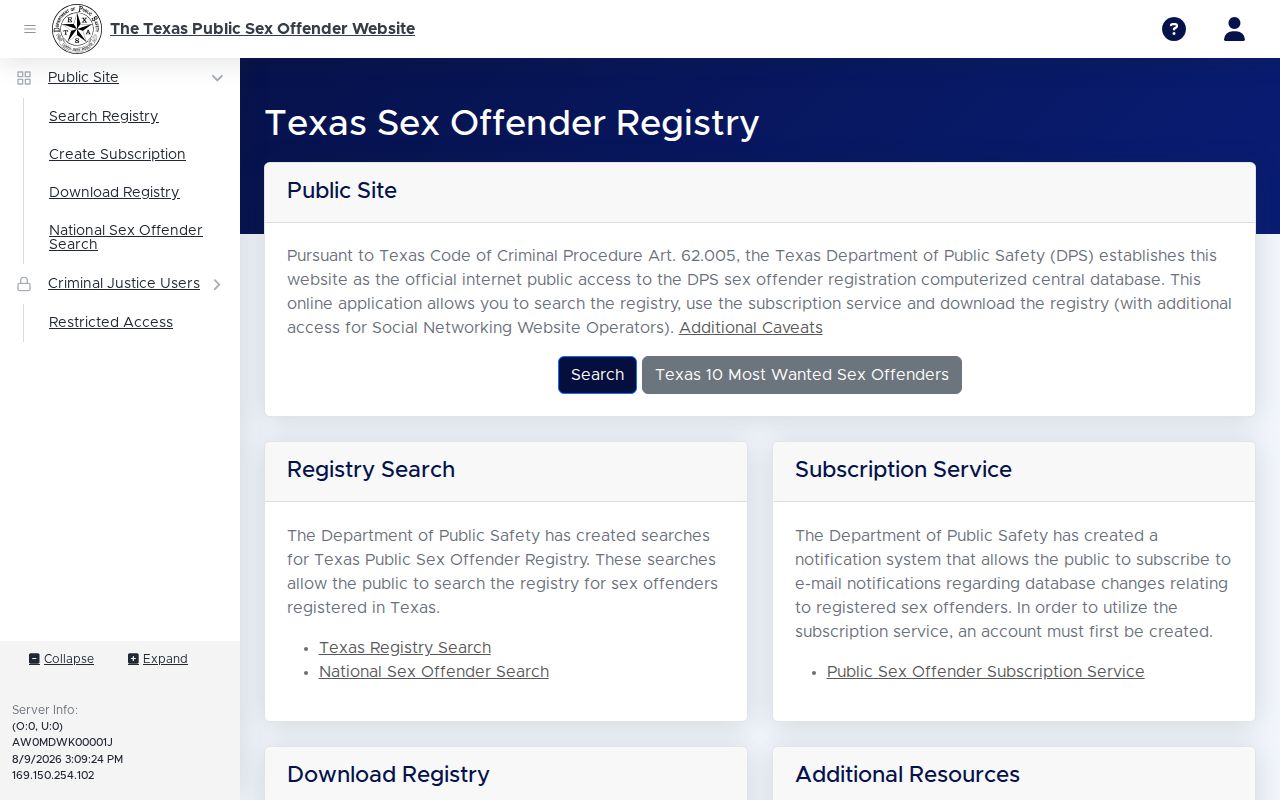
The interface is the right place to confirm current field choices because its dynamic controls can change.
Shelby County Registry Program Context
The Texas DPS registration program explains the state framework behind every Shelby County registry entry. Local authorities collect the registration information, verify it on the schedule set by law, and send updates to DPS. The state portal is therefore an aggregation of local reports, not a substitute for the local source file. A lag or error should go first to the agency shown as the most recent updater.
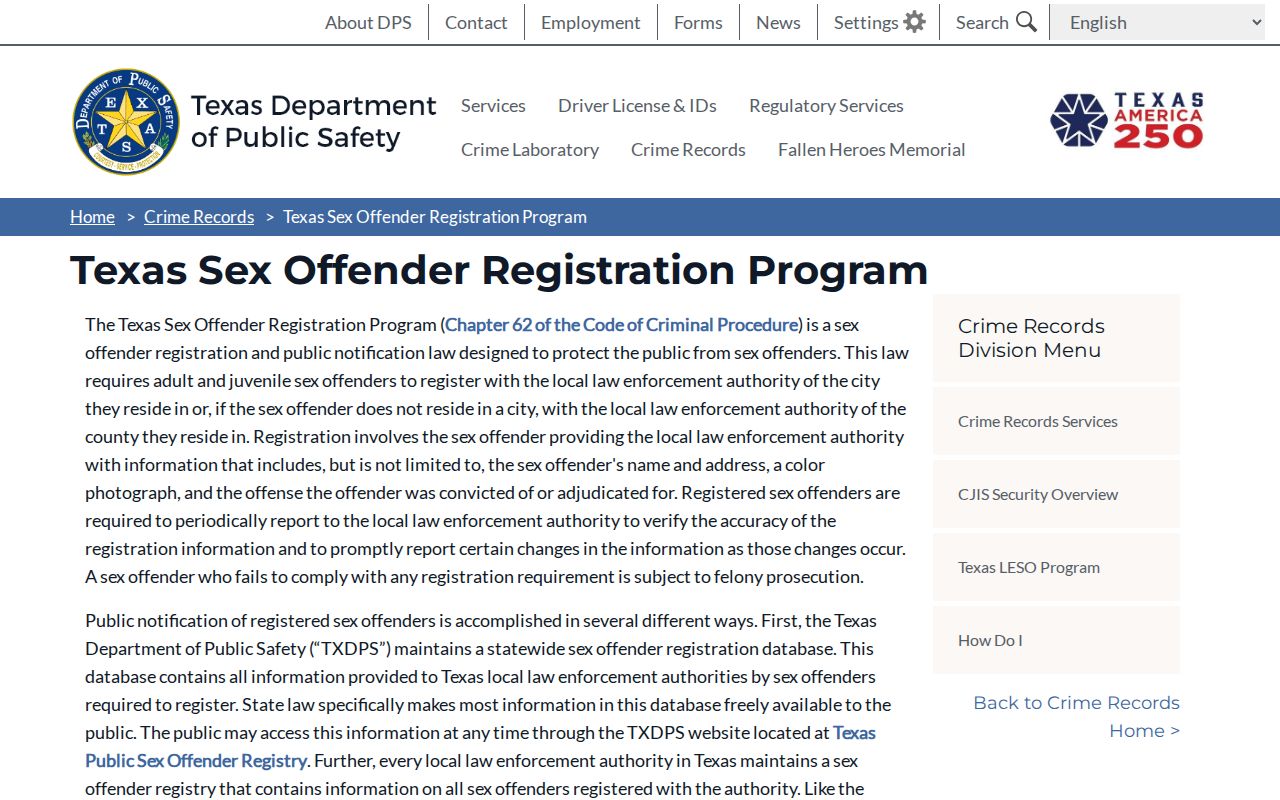
The program overview helps explain why a local move, school link, work location, or new verification can change a public profile.
A person arriving in an area must register no later than the later of the seventh day after arrival or the first date the local policy allows registration. Before a move, the person reports in person to the former authority by the seventh day before moving. After arrival in Texas, the new authority must receive the report by the seventh day. Repeated visits lasting more than 48 straight hours at least three times in a month can also create a duty. Failure to comply is a felony, so timing and the correct local authority both matter.
What a Registry Profile Shows
A Shelby County public profile may display enough detail to distinguish people with similar names. The underlying local registration file contains more than the public sees. Texas law excludes sensitive identifiers and victim information even while making core safety facts available. Treat a profile as a structured government record. Read the offense, dates, punishment, status, and updating agency together instead of relying on the image or address alone.
| Name and aliases | Public name variations used to identify the registrant. |
|---|---|
| Image and description | Photo plus such traits as sex, race, height, weight, eyes, and hair. |
| Residence | Public address or geographic description reported through the local authority. |
| Offense record | Offense, conviction date, victim age category where public, punishment, and related dates. |
| Risk and status | Risk level, civil-commitment status, and published release or supervision facts. |
| Other public data | Qualifying school, license, and vehicle information when the statute permits display. |
Public display excludes Social Security and driver-license numbers, phone numbers, online identifiers, employer contact details, victim-identifying facts, and extra information DPS requires but the statute does not release. Juvenile registration can also be ordered nonpublic. A blank field does not prove that the underlying agency never collected the information.
Correcting Shelby County Registry Details
An old address or other apparent error should not prompt a personal confrontation. Note the updating agency named on the Shelby County profile, preserve the public record details needed to identify the entry, and report the concern to that agency. DPS directs correction questions toward the most recent updater because that office can compare the public display with its registration file. If the listed authority is the sheriff, use the current published office number. If it is a city police department, use that department's official contact.
Moves can create entries at both the former and new authority while reports are processed. Work and school duties may also explain why a person appears outside the place a searcher expected. The public profile should be read on its own terms rather than as proof of a violation. Report suspected noncompliance through official law-enforcement channels. For an urgent threat, use emergency services; the registry itself is not an emergency dispatch system.
Note: The updating agency can check source data; a searcher should not attempt to investigate or verify a residence in person.
Registration Requirements and Levels in Texas
Texas assigns risk levels, but those labels do not by themselves set how long a person registers. Level 1 means low danger and a person is viewed as not likely to reoffend sexually. Level 2 reflects moderate danger and a possibility of continued offending. Level 3 reflects serious danger and an assessment that offending will continue. Civil commitment is a separate court status for a sexually violent predator. Shelby County searches should pair the risk label with the offense-based duration rule and the profile's current status.
| Category | Public effect | Duration | Verification |
|---|---|---|---|
| Level 1 low | Public fields shown with statutory exclusions | Offense sets ten years or life | Ordinarily annual |
| Level 2 moderate | Public fields shown with statutory exclusions | Offense sets ten years or life | Depends on statutory status |
| Level 3 high | High-risk community notice can apply | Offense sets ten years or life | Depends on statutory status |
| Civil commitment | Civil status and qualifying notice are public | Separate court-designated status | Every 30 days |
Adults register for life or for ten years measured from the later applicable discharge, release, community-supervision end, or deferred-dismissal date. Article 62.101 ties lifetime registration to listed offenses and repeat situations, not simply to Level 3. Juvenile delinquency registration generally ends on the tenth anniversary of disposition or completion, whichever comes later. People with two or more sexually violent offenses verify every 90 days. Others generally verify once per year.
Shelby County National Registry Search
The national site is useful when a person may have moved across a state, territorial, or tribal boundary. It searches participating public registries through one federal doorway. It does not replace Texas DPS for a close reading of a Shelby County entry, and state systems can differ in what they publish. Begin with Texas for local facts, then use NSOPW to widen the geographic scope.
The official National Sex Offender Public Website is the supported cross-state layer.
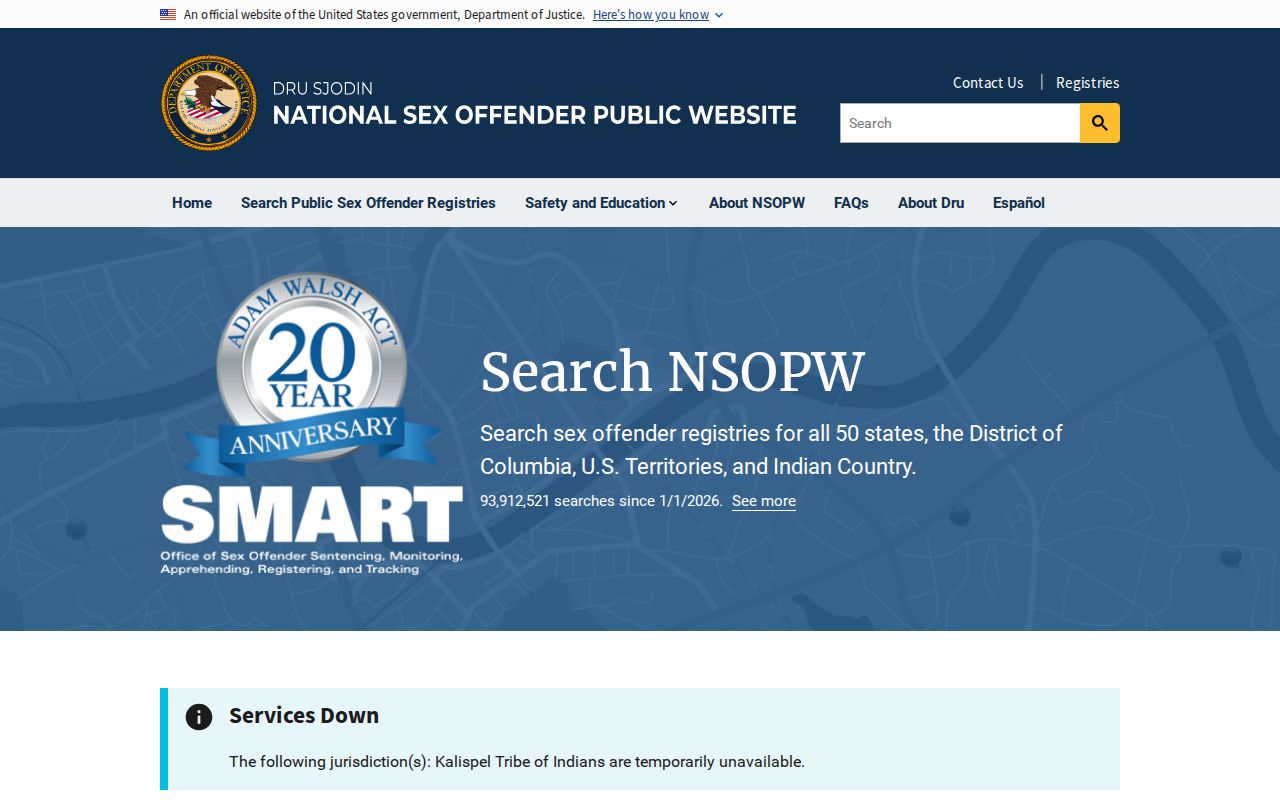
This national interface helps avoid the false assumption that a Texas-only result covers every jurisdiction.
Shelby County Registry Notifications
Texas uses targeted community notice for some high-risk moves. A high-risk or civilly committed registrant's relocation can prompt bilingual postcards to addresses within one mile in an unsubdivided area or within three blocks in a subdivided area. Schools receive notice when the statute requires it. Local authorities may also publish notice that meets the law. These measures differ from a general alert subscription, and the research did not identify a Shelby County email or proximity-alert signup. Do not promise one.
Texas Code of Criminal Procedure Chapter 62 does not impose one broad statewide residency buffer. Supervision terms and a valid local ordinance can impose different limits, but no Shelby County-specific distance rule was found in the official sources reviewed. A search result near a school or park does not alone show that a residence violates a rule. Confirm the person's status and the governing local or supervision condition through the responsible authority.
Lawful Use and Community Notification
Registry records exist for public safety and informed community awareness. They can support a family safety plan, help someone recognize official notification, or let a resident check a location through a government source. They do not authorize threats, intimidation, trespass, harassment, vigilantism, or another crime. A Shelby County sex offender check must be used within the limits stated by DPS and Texas law.
Use registry data lawfully: Texas Code of Criminal Procedure Chapter 62 warns that registry information may not be used to harass, threaten, intimidate, or commit a crime.
Public access is also bounded by the statute. Protected identifiers, victim facts, and some juvenile information stay outside the public view. If a profile seems to disclose restricted data, contact the updating agency or DPS rather than republishing it. Always verify a material fact with the office that maintains the source record.